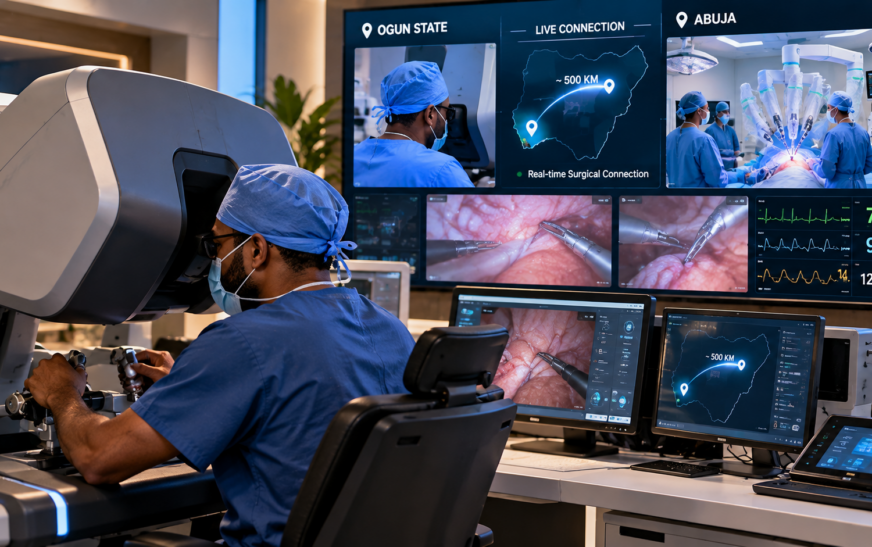
A patient was lying on an operating table in Abuja while the surgeon guiding the operation was hundreds of kilometres away in Ogun State. That sounds like a scene written for a future that has not arrived yet. In Nigeria, however, it happened in September 2026. Professor Obi Ekwenna-Davis controlled a surgical robot from Redeemer’s Health Village in Mowe while a patient at Nisa Premier Hospital in Abuja underwent surgery for a cancerous kidney.
The procedure was a telesurgery-assisted, robot-assisted right radical nephrectomy, meaning the affected kidney was removed. Redeemer’s Health Village, RoboMed Global and Nisa Premier Hospital collaborated on the operation, which was carried out in real time across roughly 500 kilometres. Reports described it as Nigeria’s first tele-robotic surgery and, according to the institutions involved, the first of its kind in West Africa.
It is tempting to look at a story like this and make the robot the main character. After all, a machine physically carried out movements inside a patient while the surgeon operating its controls was in another state. But that description can hide the more important reality. The robot did not wake up, diagnose the patient, decide what needed to be removed and perform an operation independently. Human expertise remained at the centre of the procedure.
“Sometimes the most impressive thing about advanced technology is not what the machine can do alone, but how much further human skill can travel through it.”
That distinction matters at a time when the word automation can make technology sound as though people are gradually disappearing from important work. In this operation, Professor Ekwenna-Davis’s movements at the console were transmitted to the robotic system in Abuja. A medical team was also physically present with the patient, and contingency arrangements were in place so that someone on site could intervene if necessary. Technology extended the surgeon’s reach; it did not remove the need for surgeons, nurses, medical judgement or preparation.
This is where the event becomes bigger than one successful operation. Specialist knowledge has traditionally travelled with the specialist or required the patient to travel towards it. When geography separates expertise from need, somebody has to cross that distance. Tele-robotic surgery introduces another possibility: under the right conditions, expertise itself can travel digitally while the patient remains where the physical care is being delivered.
That possibility could matter greatly in places where specialist medical expertise is concentrated in a few cities or institutions. It does not mean every hospital can suddenly perform remote surgery. The Nigerian procedure depended on robotic equipment, reliable telecommunications, trained professionals and teams working together at different locations. Reports said the connection used Starlink, with MTN providing backup connectivity. In a procedure where instructions must travel in real time, connectivity is not merely convenient infrastructure. It becomes part of the environment in which care is delivered.

“The future of technology may not always be about replacing where people work. Sometimes it will be about allowing their knowledge to reach places their bodies cannot reach quickly enough.”
There is also a quieter lesson here about innovation. New technology often attracts attention because of the machine itself: the robot, the software, the artificial intelligence or the screen. Yet successful technology usually depends on an ecosystem around it. Someone must be trained to use it. Someone must maintain it. A network must carry information reliably. Procedures must exist for failure. Professionals must understand when the technology should be trusted and when human intervention must take over.
Redeemer’s Health Village has said training will be important to sustaining robotic surgery, and Ekwenna-Davis has discussed plans for a robotic academy aimed at training medical professionals. That may prove as significant as the equipment. A sophisticated machine can arrive in a country once; building people who can use, support and improve what it enables is what turns an impressive demonstration into lasting capacity.
The event also changes the way distance can be imagined. Five hundred kilometres remains five hundred kilometres on a map. Roads have not become shorter, and Abuja has not moved closer to Ogun State. What changed was what that distance could prevent. For one procedure, specialist surgical movements crossed it almost instantly.
That does not mean geography has become irrelevant, or that remote surgery should be treated as effortless. It means technology can sometimes change the practical meaning of distance without changing the distance itself.
Perhaps that is the most interesting part of what happened between Mowe and Abuja. The robot deserves attention, but the deeper story is about connection: between hospitals, between medical teams, between infrastructure and expertise, and between a surgeon’s hands and a patient hundreds of kilometres away. Technology did not remove the human being from the operating room story. It gave human skill a longer reach. And that may be the breakthrough worth remembering most.