There is a strange thing happening with technology. Almost every inconvenience now appears to have a tool waiting to solve it. There are tools for writing, scheduling, designing, researching, summarising meetings, answering customers, analysing documents and organising work. Artificial intelligence has accelerated this further because one tool can now perform tasks that previously required several pieces of software.
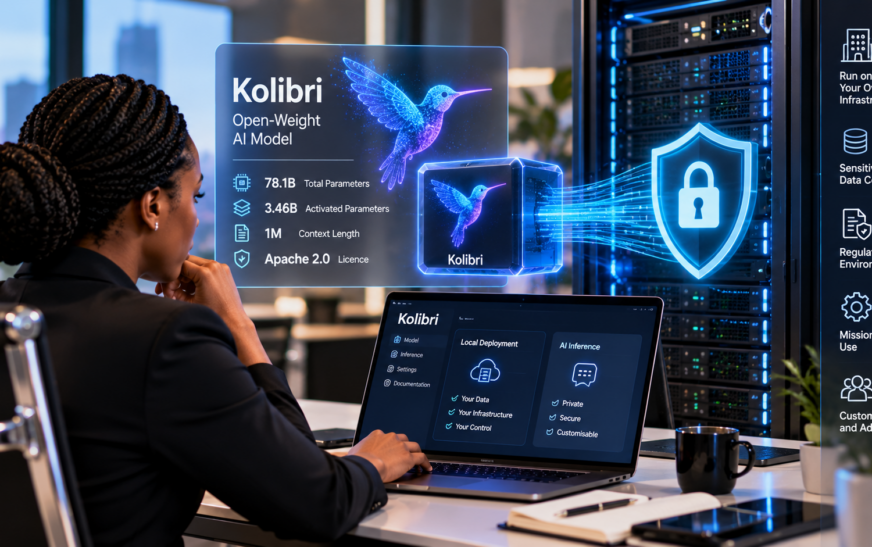
Yesterday, another artificial intelligence model entered that already crowded world. Kolibri was released as an open-weight language model with 78.1 billion total parameters, although only about 3.46 billion are activated for each token it processes. It can handle a context of up to one million tokens, supports different levels of reasoning and can be downloaded with its full weights under an Apache 2.0 licence.
Those numbers will interest technical people, but there is a more ordinary question hiding underneath them.
Where does our information go when we use intelligent tools?
That question becomes more important as technology moves deeper into work. Asking artificial intelligence to suggest a dinner recipe is one thing. Asking it to examine internal company documents, contracts, financial information, government records or confidential research is something entirely different. The usefulness of the tool increases, but so does the importance of understanding what happens behind the screen.
“The more useful technology becomes, the less sensible it is to judge it only by what it can do. We also need to understand what using it requires us to give away.”
This is what makes yesterday’s release interesting beyond another artificial intelligence announcement. Kolibri has been positioned for situations where organisations may want to operate an artificial intelligence model on their own infrastructure instead of sending internal information to an outside inference service. Its creators particularly identify regulated and mission-critical environments among the intended uses.
The idea points towards something that is becoming easier to overlook.
Convenience has trained us to think about technology from the front. We open an application, type something, receive an answer and continue with our day. Most of what happens behind that interaction remains invisible. We rarely need to know which servers processed the information, where those servers are located, how the system was built or how much control the provider has over the environment.
For ordinary activities, that invisibility can feel harmless. In serious organisations, it can become a business question.
Imagine a law firm using artificial intelligence to examine hundreds of confidential case documents. Imagine an engineering company feeding proprietary designs into a system. Think about a hospital analysing sensitive information or a public institution processing records that cannot simply move wherever convenient. Suddenly, choosing an artificial intelligence tool involves more than asking which one produces the smartest answer.
It involves asking who controls the environment in which that answer is produced.
“Sometimes the most important technology decision is not choosing the smartest tool. It is deciding how much control we are willing to surrender in exchange for convenience.”
This does not mean every organisation needs to own its artificial intelligence infrastructure. Running sophisticated models locally requires computing resources, technical knowledge, maintenance and money. Cloud based systems became popular for good reasons. They remove much of that burden and allow businesses to access powerful technology without building everything themselves.
The interesting development is that the conversation is expanding.
We spent years asking what artificial intelligence could do. Write this. Summarise that. Generate an image. Analyse this spreadsheet. Build this presentation. Answer this customer. As those abilities become normal, a second generation of questions is beginning to matter: Where does the system run? Who controls it? Can it operate privately? Can an organisation inspect or adapt it? What happens when the organisation does not want its most sensitive work leaving its own technological environment?
That shift tells us something about technological maturity. When something is new, capability attracts attention. When it becomes important, control starts attracting attention too.
The release also challenges the assumption that progress must always mean another application appearing on another screen. Sometimes technological progress happens deeper down, where ordinary users may never see it. Giving developers access to model weights, allowing organisations to deploy systems on their own hardware and building technology for environments with stricter information requirements may not produce the excitement of a new consumer gadget, but these decisions influence how deeply artificial intelligence can enter serious work.
Perhaps this is where the problem with having a tool for everything becomes clearer. The problem is not simply that there are too many tools. It is that convenience can encourage us to collect technology faster than we develop the judgement required to understand our relationship with it.
Yesterday’s model release will probably become one announcement among many in an industry moving extraordinarily quickly. Another model will arrive. Another benchmark will improve. Another feature will promise to save time.
But the more technology becomes capable of entering every corner of work, the more important a quieter question becomes.
Before asking what the next tool can do for us, we may need to understand what happens to us, our information and our control when we allow it in.